PANEL & TALKS
Speaker at UX Career Panel – UW Seattle, GIX
Panel Q&A — UX Careers, AI, and Finding Your Design Identity
Unadulterated by AI — live responses from my conversation at the University of Washington's Global Innovation Exchange (GIX).
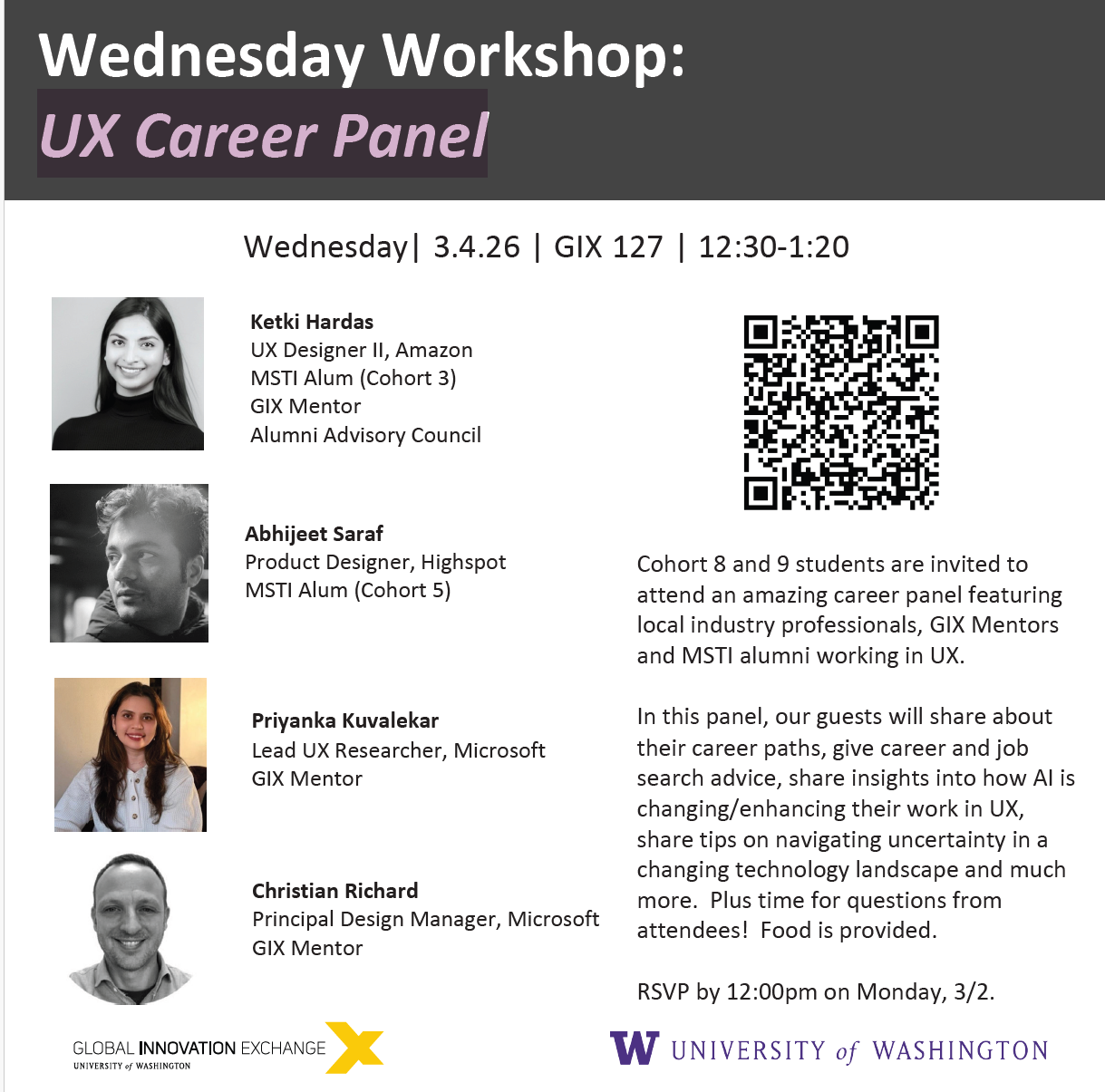
UX Career Panel at UW Seattle, GIX
What kind of projects do you normally work on, and what do you enjoy and find challenging?
I enjoy abstract discussions and systems thinking, and I have an affinity for emergence theory. I like to watch and create situations that create controlled emergence. To define it in simple terms, I make decisions and choices that have predictability in the future. To perform this closely in our design loop, design systems are closest to work on, where we have a great capacity to test some of these theories.
Controlled Emergence - To define it in simple terms, I make decisions and choices that have predictability in the future.
On a day-to-day basis, yes, I design components in Figma and write them in React, but overall, my guidance comes from applying systems thinking rooted in controlled emergence.
How have you experienced AI changing and/or enhancing your work? How have you seen AI affecting colleagues — PMs and developers?
I would begin by saying, it's in grey areas and infusing roles, yet I am not sure about the sustainable hybridization of roles from a systems front. Vibe coding has a vibe, certainly, but its value factor is questionable across the industry — no one knows how to tame the AI horse. We have sort of established a meta identity for ourselves in our roles and titles, and that's one of the biggest barriers for enterprises to create a more lean, code-first structure.
If I were to address practical situations, at least PMs at Highspot are still too busy using other AI tools and understanding customers, so none of them have come with a working prototype in Cursor yet. But I've heard that the implications are real across the industry, and designers are not just building — they are evaluating dozens of interactions thrown at them and how they truly fit in their semantic structure.
The biggest hit and inflection is in the developer paradigm — they are expected to peak in this whole software development tree.
What advice would you share about navigating the current UX job market and evolving technology ecosystem?
Ideally, have a T-factored skillset — have good horizontal skills, including AI and interpersonal skills. But at the same time, no amount of AI can shake the foundational requirements for a human to judge or read between the lines for customers and users.
I'll be honest — I am pretty bad at lying or faking. It's hard for me to create connections that are projecting rewards, for example being a mentor, or seeking help for referral favors at their companies. I have always believed more in serendipity and time as factors that influence our destinations. I have struggled to ask someone for a coffee chat when eventually I know that they know I would later ask for a job in their team. It's not bad; it just doesn't feel authentic.
You don't need to rely on what I say — have your own principles and stand by them. There are some negotiables and some non-negotiables; weigh in some thought and make sure your circumstances don't bend you to make immediate compromises.
Performing at the job is a done deal — most of us can do that eventually — but building solid foundations in leadership and planning long-term identity will truly pay off.
What worked for me? Honest, simple cold mails and plenty of feedback from previous interviews. They are my foundations to be clear on what I need to demand in my next role.
Are there any industry groups or resources you'd recommend for making connections and staying current with UX?
As I mentioned, I am pretty bad at this, and I have suffered the consequences. Let's break it down a little bit. I wouldn't say it's my ego that rejects bending down to seek a helping hand. It's more about how authentic and natural you come across to people who would work with you eventually.
We are ideally more married to our jobs than to our partners. Well, if you have a partner, you know your preferences, so why not for the roles? I tell you, everything can influence you — immigration, money, to name a few — but let's park that aside for a while and ask the best you can. If you feel great meeting new people and have the capacity to maintain those relationships, sure! Go ahead with a gazillion conferences. Else, best is to invest in mentorship — be frugal here, don't overspend — but can't complain, structures around us are built on reward functions, and they are fine until people overexploit them.
What is your design philosophy?
The panel pondered in silence.
I came across silence, space, and emptiness as elements that define me, and it's not easy to reach here. Neither are they requirements for you to be successful — some people are purely rational and build great careers in design — but this question has a genesis; it's you trying to find yourself through your work. Specifically, design challenges you to touch on the abstraction layer of things around us.
We are also influenced by other great designers who have fundamental philosophies, but I would suggest — don't rush for that and stay with this question. Experiment with some abstraction like entropy and emptiness and see if they resonate with your work.
I guess the smart ones will not be stuck with one philosophy — they can sort of be indifferent to these meta identities and keep things simple. That's where most people land eventually.
What do you do for fun outside of work? How do you balance life and work?
I am a meditation coach. I facilitate SKY practice and the Art of Living Part 1 program, and I have seen people change and fight anxiety, depression, and all other issues that modern society throws at us. This is one that I have consistently done for the past 15 years — yes, 15! Like I told you, developing philosophies is not an easy ride — it first develops your character and later reflects in your work.
Apart from that, I am a Vedic astrologer, love to play Rocket League, and tie my day around a quick run in nature.